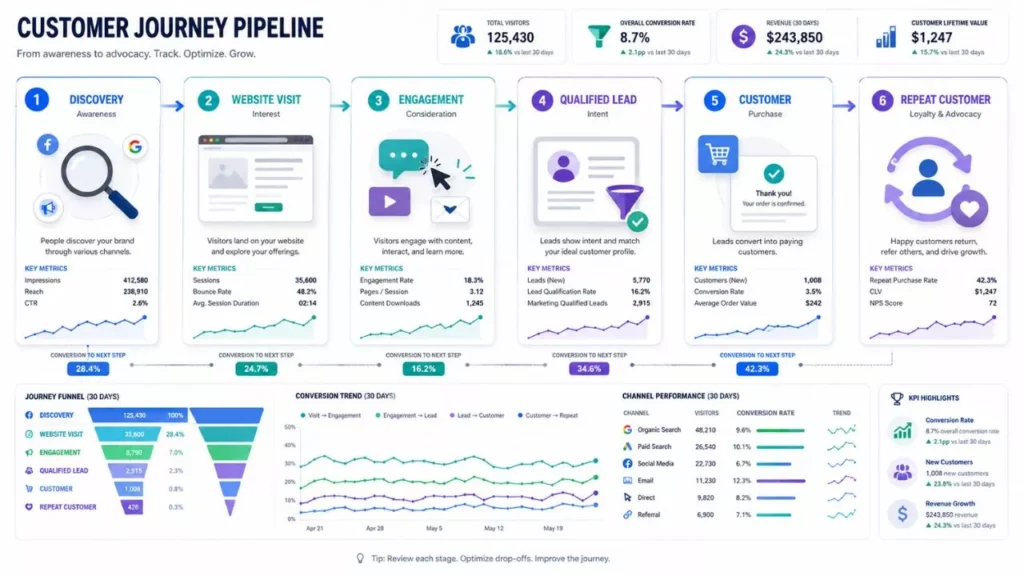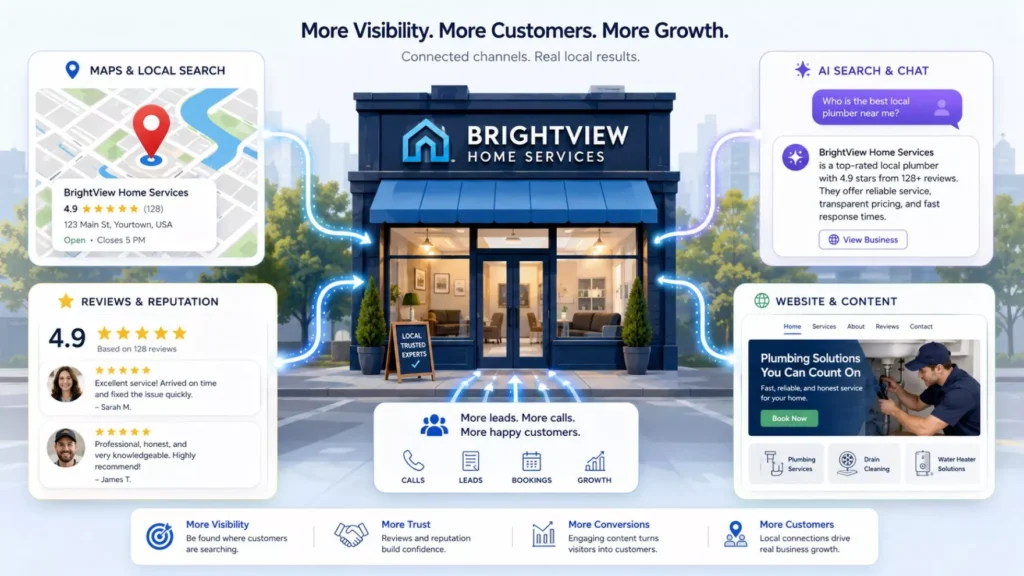
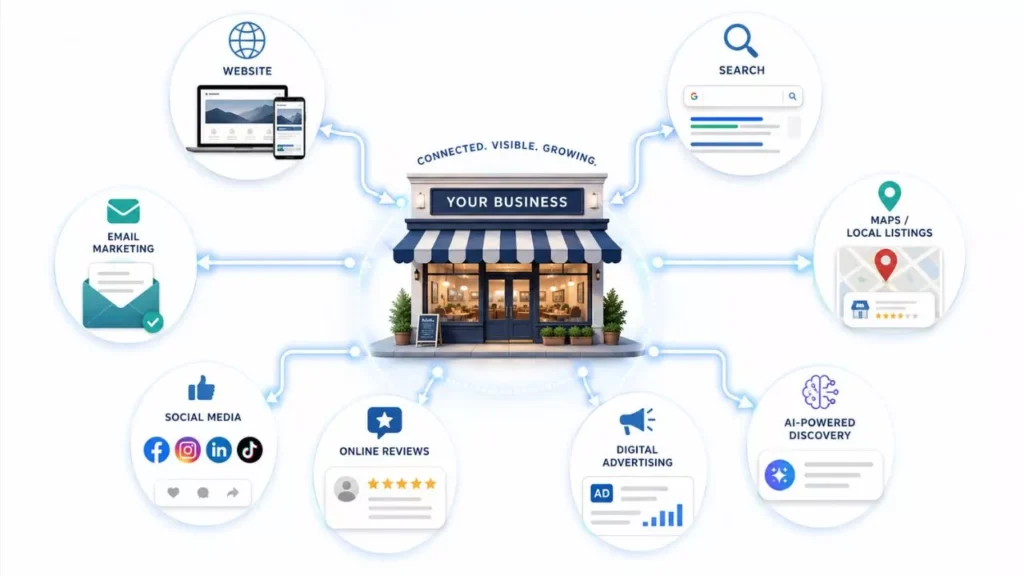
Digital marketing gives small businesses multiple ways to reach customers without relying entirely on traditional advertising. A business can use search engines, maps, websites, social media, email, reviews, online advertising, and increasingly AI-powered discovery platforms to connect with potential customers.
The challenge is deciding where to focus.
The most useful digital marketing tips for small businesses are not about being everywhere. Start with a clear customer, a measurable goal, a useful website, strong search visibility, trustworthy content, and channels that match how your customers actually discover and evaluate businesses.
Here are 12 practical strategies small business owners should know.
What Is Digital Marketing for a Small Business?
Digital marketing is the use of online channels to attract, engage, convert, and retain customers. For a small business, those channels can include a website, search engines, local listings, social networks, email, online advertising, review platforms, and AI-powered search experiences.
A good strategy connects these channels rather than treating each one as a separate project.
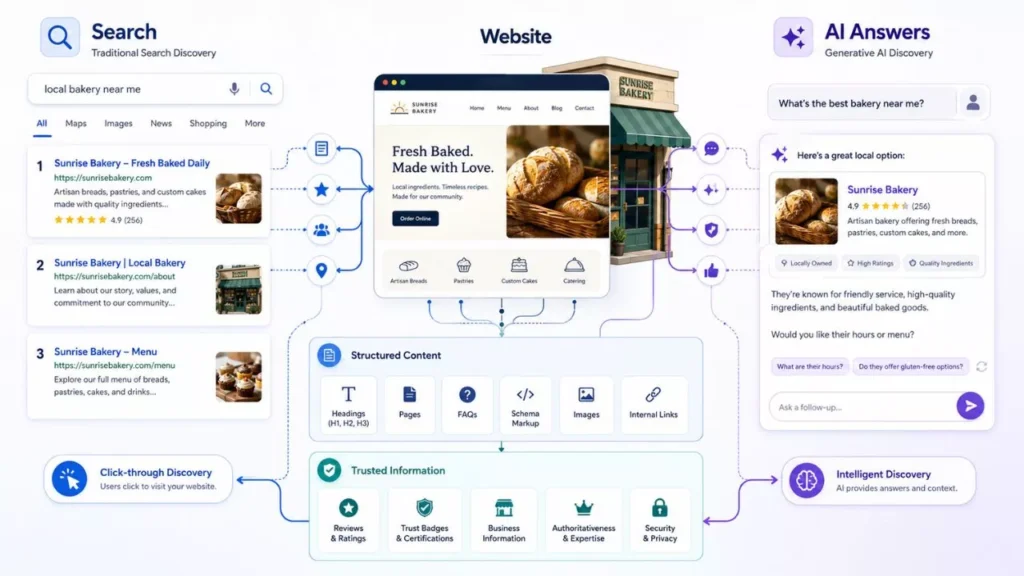
For example, an educational article may attract someone through Google, answer a question cited or surfaced by an AI system, provide material for a social post, and encourage the visitor to join an email list or request a quote.
Why Digital Marketing Matters for Small Businesses
Customers often research a business online before deciding whether to contact, visit, or purchase from it.
Your digital presence therefore influences more than discovery. It can affect trust and purchasing decisions.
A strong online presence helps a business communicate:
- What it offers
- Who it serves
- Where it operates
- Why customers should consider it
- How customers can get started
Digital marketing also provides measurable signals. Instead of judging success only by impressions or followers, businesses can monitor inquiries, bookings, purchases, calls, qualified leads, and other actions connected to revenue.
1. Start With a Clear Marketing Goal
Don’t begin by choosing a platform. Begin by deciding what you want marketing to accomplish.
Your primary objective might be to generate consultation requests, increase online sales, attract customers to a physical location, book appointments, build an email audience, or increase repeat purchases.
Turn the objective into something measurable.
For example, rather than saying, “We need more social media activity,” define the business outcome you expect social media to support.
A clear objective makes it easier to select channels and determine whether your investment is working.
2. Know Your Ideal Customer
Effective marketing begins with understanding the person you want to reach.
Identify the customer’s problem, priorities, location, typical questions, objections, preferred communication channels, and factors influencing their purchasing decision.
Consider the difference between what your company calls a service and what a customer actually searches for.
Customers frequently search around problems and questions rather than industry terminology.
That difference should shape your website pages, advertisements, FAQs, articles, and social content.
3. Build a Website That Converts Visitors
A website shouldn’t simply prove that your business exists. It should help visitors decide what to do next.
Important pages typically include:
- Homepage
- Product or service pages
- About page
- Contact page
- Relevant location pages
- Frequently asked questions
- Helpful resources or articles
Make important information easy to find, particularly on mobile devices.
Each key page should also have an appropriate next action, such as request a quote, schedule an appointment, call now, buy online, or contact us.
Avoid forcing visitors to search through multiple pages before they understand what you offer.
4. Invest in SEO
Search engine optimization helps search engines understand your website and helps potential customers discover relevant pages.
For small businesses, SEO should start with fundamentals rather than tricks.
Create pages around genuine customer needs, use descriptive titles and headings, make navigation logical, provide useful original information, and address technical problems that prevent pages from being accessed or used properly.
Keywords remain useful because they reveal how people describe their needs. However, forcing a phrase into every paragraph can make content less helpful.
Use keywords naturally while covering the broader topic comprehensively.
5. Strengthen Your Local Search Visibility
For businesses serving a geographic area, local visibility can be particularly valuable.
Maintain accurate information about your company, including its name, contact information, operating hours, services, and service area where relevant.
For eligible businesses, an accurate Google Business Profile can help customers find business information through Google Search and Maps.
Location pages can also be useful when a company genuinely serves multiple areas. Each page should provide meaningful information for that location instead of reproducing the same text with a different city name.
Local marketing ultimately depends on relevance and trust, not simply mentioning a city repeatedly.
6. Create Content That Solves Customer Problems
Content marketing works best when it helps someone make a better decision.
Useful formats include:
- How-to guides
- Buying guides
- Service explanations
- Checklists
- Comparisons
- Frequently asked questions
- Original research or data
- Case studies based on verifiable business experience
Start by collecting questions your customers repeatedly ask.
If people regularly ask about costs, timelines, differences between services, preparation, maintenance, or choosing a provider, those questions can become useful content topics.
One comprehensive resource that answers an important question well can be more valuable than numerous thin articles created simply to target keywords.
7. Prepare Your Content for AI-Powered Discovery
Search behavior now extends beyond traditional lists of links. Consumers may also use generative AI and AI-powered search experiences to research products, businesses, and problems.
This is where Generative Engine Optimization (GEO) becomes relevant.
GEO focuses on making information clear, contextual, credible, and easy for generative systems to interpret and potentially reference.
Small businesses can support both human readers and machine understanding by clearly stating factual information about:
- What the business does
- Products and services
- Locations or service areas
- Relevant expertise
- Pricing when appropriate
- Policies
- Contact options
- Common customer questions
Use descriptive headings and answer important questions directly before expanding on them.
For factual claims that require evidence, link to authoritative sources. For claims about your own company, only publish information you can substantiate.
GEO should complement—not replace—good SEO and useful content.
8. Choose Social Media Channels Carefully
Small businesses rarely need to be equally active on every social network.
Choose platforms based on your audience, business model, and content capabilities.
A visually oriented consumer business may benefit from visual platforms, while a B2B company may prioritize professional networks. Some businesses may find that video or community-based platforms fit their audience better.
Your social strategy can include educational posts, product demonstrations, behind-the-scenes material, company updates, answers to common questions, and customer stories shared with appropriate permission.
Consistency on a few relevant channels is generally more manageable than maintaining weak profiles everywhere.
9. Build an Email List You Own
Social audiences depend on third-party platforms. An email list provides a more direct way to communicate with people who have chosen to hear from your business.
Give visitors a legitimate reason to subscribe.
Depending on your business, that could include useful educational updates, product announcements, relevant offers, event information, or a valuable resource.
Segmenting subscribers can make communication more relevant. For example, existing customers may need different messages from prospective customers.
Always follow applicable privacy, consent, and commercial email requirements in the markets where you operate.
10. Earn and Manage Customer Reviews
Reviews can play an important role in how potential customers evaluate a small business.
Make it simple for genuine customers to leave feedback on platforms relevant to your company.
Respond professionally to both positive and negative reviews. A thoughtful response demonstrates that your business listens to customers.
Never fabricate reviews or create misleading testimonials. Authenticity matters to customers, platforms, and your long-term reputation.
Feedback can also reveal recurring questions or problems that should be addressed elsewhere in your marketing.
11. Use Paid Advertising Strategically
Paid advertising can create immediate visibility, but spending money doesn’t automatically create profitable growth.
Before launching campaigns, define the conversion you want.
That might be a purchase, appointment, phone call, quote request, or qualified lead.
Make sure the landing page closely matches the advertisement. Someone clicking an ad for a specific service should normally arrive at a page explaining that service rather than an unrelated homepage.
Start with controlled budgets, track conversions, and evaluate lead quality alongside acquisition cost.
12. Measure Results That Affect the Business
Marketing metrics only become valuable when they help you make decisions.
Depending on your goals, useful measurements can include:
| Metric | What It Helps You Understand |
| Website conversions | Whether visitors complete desired actions |
| Qualified leads | Whether marketing attracts appropriate prospects |
| Conversion rate | How efficiently traffic produces outcomes |
| Customer acquisition cost | What acquiring customers costs |
| Revenue | Whether marketing contributes to sales |
| Organic search traffic | How visitors discover you through search |
| Email conversions | Whether email contributes to desired actions |
| Repeat purchases | Whether customers return |
Don’t evaluate a strategy based only on likes, impressions, or traffic.
A smaller campaign that produces profitable customers may be more useful than a larger campaign producing attention without meaningful business outcomes.
Common Digital Marketing Mistakes Small Businesses Should Avoid
One common mistake is attempting too many tactics simultaneously.
A small team can easily end up managing multiple social accounts, paid campaigns, a blog, email marketing, SEO, and video without doing any of them particularly well.
Other mistakes include:
- Marketing without defined goals
- Neglecting mobile website usability
- Publishing generic AI-generated content without fact-checking or added value
- Ignoring local search visibility
- Buying or fabricating reviews
- Targeting keywords without considering intent
- Failing to track conversions
- Continuing ineffective campaigns because they generate vanity metrics
- Making business claims without evidence
- Failing to update important information
Prioritization matters. Build a strong foundation, measure it, and expand based on evidence.
Frequently Asked Questions
What are the best digital marketing tips for beginners?
Start by defining your customer and marketing objective. Build a clear website, establish relevant search and local visibility, publish genuinely useful content, collect authentic customer feedback, and measure conversions. Add new marketing channels only when you have the resources to manage them effectively.
What is the most effective digital marketing strategy for a small business?
There is no single strategy that works best for every business. The right combination depends on your audience, industry, location, purchasing journey, competition, and budget. A local service company may prioritize local search and reviews, while an ecommerce business may use a different mix.
How much should a small business spend on digital marketing?
There is no universal amount that suits every company. Set spending according to your goals, margins, customer value, available cash, and acquisition economics. Begin with measurable activities and adjust investment based on results rather than relying on an arbitrary percentage.
Does a small business still need SEO?
SEO can be valuable when potential customers use search engines to research the problems, products, or services your company addresses. Its importance relative to other channels depends on how your particular audience discovers businesses.
What is GEO in digital marketing?
Generative Engine Optimization, or GEO, is an emerging approach to making information clear, authoritative, contextual, and accessible to generative AI systems. It complements traditional SEO by considering how information may be discovered and synthesized in AI-powered experiences.
Can small businesses use AI for digital marketing?
Yes. AI tools can assist with research, brainstorming, drafting, analysis, and repetitive tasks. Businesses should still review outputs for accuracy, originality, brand alignment, privacy considerations, and unsupported claims before publishing.
How can I tell whether my digital marketing is working?
Connect marketing activities to measurable business outcomes. Track qualified leads, sales, bookings, conversion rates, customer acquisition costs, and other metrics relevant to your goals. Compare performance over time and use the results to decide where to invest next.
Conclusion
The most important digital marketing tips for small businesses share one principle: focus on helping the right customer rather than chasing every new platform or tactic.
Build a strong website, improve search and local visibility, publish useful content, earn customer trust, maintain an email audience, use advertising carefully, and prepare your information for emerging AI-powered discovery.
Then measure what happens.
Digital marketing becomes far more useful when every channel has a clear purpose and every major investment can be connected to a meaningful business outcome.