Artificial intelligence is changing how people discover information online. Instead of scrolling through pages of search results, many users now ask AI assistants to provide direct answers. This shift is creating a new discipline known as Generative Engine Optimization (GEO).
If your business relies on online visibility, understanding what is GEO is becoming increasingly important. While traditional search engine optimization (SEO) remains valuable, businesses now need content that AI-powered search experiences can understand, trust, and reference.
Understanding what is GEO is crucial as it shapes how your business approaches online visibility. Every business should explore what is GEO to ensure they’re not left behind in the digital landscape.
In this guide, you’ll learn what GEO is, how it works, how it compares with SEO, and practical ways to prepare your website for the future of online discovery.
To fully appreciate what is GEO, one must also consider the broader implications for marketing strategies.
What Is GEO?
By grasping what is GEO, organizations can align their content strategies with modern search technologies.
Generative Engine Optimization (GEO) is the practice of creating and organizing digital content so AI-powered search systems can easily understand, interpret, and use it when generating answers for users.
The increased focus on what is GEO indicates a shift not just in technology, but in consumer behavior as well.
Understanding what is GEO allows businesses to leverage AI technology more effectively.
Unlike traditional search engines that primarily display lists of web pages, generative AI platforms often provide direct, conversational responses by combining information from multiple trusted sources.
The goal of GEO is to increase the likelihood that your content becomes useful, understandable, and reference-worthy within these AI-generated responses.
Rather than optimizing solely for rankings, GEO focuses on optimizing for understanding, relevance, authority, and clarity.
Why GEO Matters Today
The way people search is evolving rapidly.
Instead of typing short keywords, users increasingly ask complete questions such as:
- What is GEO?
- How does GEO differ from SEO?
- Is GEO important for small businesses?
- How can I optimize my website for AI search?
The question what is GEO should be at the forefront of every business’s strategy moving forward.
AI-powered search experiences are designed to answer these questions directly.
As these tools become more common, businesses that publish structured, trustworthy, and comprehensive content are more likely to be included in AI-generated responses.
This doesn’t mean traditional search engines are disappearing. Instead, GEO complements SEO by preparing your content for both conventional search results and AI-assisted discovery.
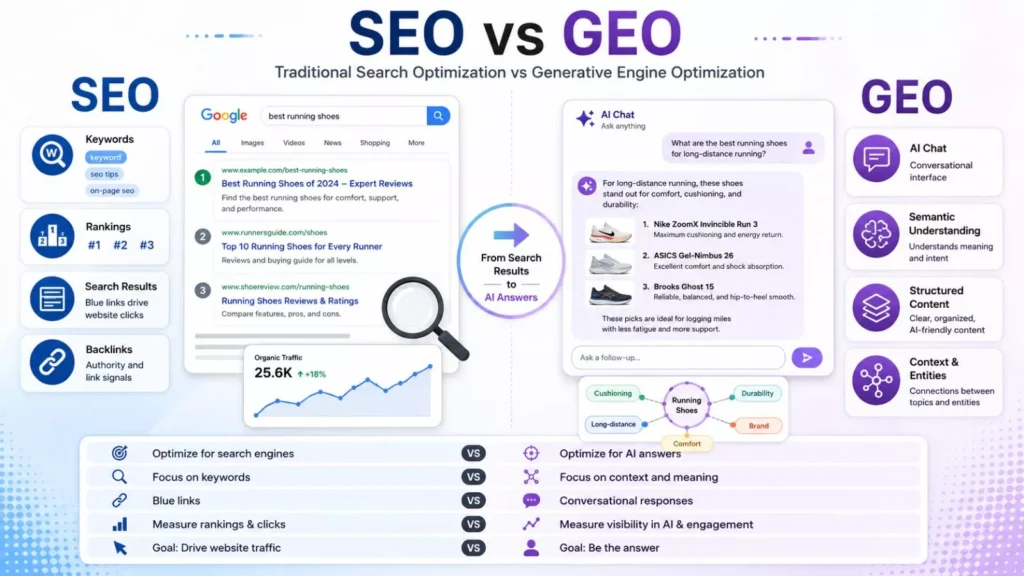
GEO vs SEO: What’s the Difference?
Although GEO and SEO share similar goals—helping users find valuable information—they optimize for different experiences.
| SEO | GEO |
| Optimizes for search engine rankings | Optimizes for AI-generated answers |
| Focuses on keywords and search intent | Focuses on context and semantic understanding |
| Encourages clicks to web pages | Supports direct answer generation while encouraging deeper exploration |
| Targets search engine algorithms | Targets AI systems that synthesize information |
| Measures rankings and traffic | Considers visibility in AI-generated responses alongside traditional metrics |
The two approaches are complementary. Businesses don’t need to choose between SEO and GEO—they benefit from combining both.
The connection between traditional SEO and what is GEO is vital for developing a comprehensive marketing approach.
How AI Search Works
Generative AI systems evaluate information differently than traditional ranking algorithms.
Although implementations vary across platforms, AI systems generally prioritize content that is:
- Clear and easy to understand
- Well organized
- Factually accurate
- Comprehensive
- Up to date
- Supported by credible sources when appropriate
- Written around complete topics instead of isolated keywords
Content that answers questions directly and provides useful context is generally easier for AI systems to interpret.
This is why structured articles with descriptive headings, concise definitions, and logical organization often perform well for AI-assisted discovery.
Benefits of GEO for Businesses
Businesses that invest in GEO can gain several advantages.
Better Visibility in AI Experiences
As AI assistants become more common, optimized content has greater potential to appear in AI-generated answers.
Improved Content Quality
Many GEO best practices also improve readability for human visitors.
Clear explanations, logical structure, and useful examples create a better user experience.
Businesses should continuously revisit what is GEO to stay ahead in this evolving field.
Stronger Brand Authority
As we explore what is GEO, it’s clear that the landscape of digital marketing is rapidly changing.
Publishing accurate, comprehensive resources helps establish your business as a trusted source within your industry.
Future-Ready Marketing Strategy
Technology continues to evolve.
Organizations that adapt early are generally better prepared for future search experiences.
Supports Existing SEO Efforts
Ultimately, understanding what is GEO will empower your marketing teams.
Many GEO improvements—such as better organization, clearer writing, and topical depth—also strengthen traditional SEO.
How to Optimize Your Website for GEO
As you address what is GEO, consider how it integrates with customer engagement strategies.

Businesses don’t need to rebuild their websites from scratch.
Instead, focus on improving content quality and clarity.
To summarize what is GEO, it’s essential for future-proof strategies.
1. Answer Questions Clearly
Start important sections with concise answers before adding detailed explanations.
This helps both readers and AI systems understand your content.
2. Organize Content Logically
Use descriptive headings and subheadings that reflect the questions users ask.
Avoid overly complicated page structures.
3. Demonstrate Expertise
Publish content that reflects genuine knowledge of your industry.
Explain concepts thoroughly and avoid vague or unsupported claims.
4. Keep Information Current
Review important pages regularly to ensure information remains accurate and relevant.
When discussing rapidly changing topics, include context about when the information was last reviewed.
5. Cover Topics Comprehensively
Instead of creating many short pages targeting similar keywords, develop in-depth resources that answer related questions in one place.
6. Use Natural Language
Write for people first.
AI systems are increasingly effective at understanding natural language and context, making readability more valuable than keyword repetition.
7. Improve Content Structure
Break large blocks of text into:
- Lists
- Tables
- Definitions
- FAQs
- Step-by-step guides
Structured content is easier for readers to navigate and easier for AI systems to interpret.
Common GEO Mistakes
Many businesses misunderstand GEO by treating it as a replacement for SEO.
Common mistakes include:
- Focusing only on keywords instead of user questions
- Publishing thin or repetitive content
- Making unsupported claims
- Ignoring content updates
- Writing exclusively for algorithms instead of readers
- Neglecting clear page organization
To thrive, businesses must adapt to the question what is GEO as a core element of their online strategy.
Successful GEO emphasizes usefulness, clarity, and credibility.
Frequently Asked Questions
Is generative engine optimization GEO replacing SEO?
No. GEO complements SEO rather than replacing it. Traditional search remains important, while GEO helps prepare content for AI-powered search experiences.
What does GEO stand for?
GEO stands for Generative Engine Optimization, a strategy focused on making content understandable and useful for AI-generated answers.
Is GEO only for large companies?
No. Businesses of all sizes can benefit from creating clear, trustworthy, and well-structured content.
Does GEO require special software?
Not necessarily. Many GEO improvements involve better content creation, organization, and maintenance rather than specialized tools.
The exploration of what is GEO will continue to shape the future of digital marketing.
Can existing SEO content be optimized for GEO?
Yes. Many existing articles can be updated with clearer explanations, improved structure, comprehensive topic coverage, and direct answers to common questions.
What types of content perform well for GEO?
Educational guides, FAQs, tutorials, definitions, comparison articles, and other well-organized resources often align well with GEO best practices.
Conclusion
As AI continues transforming how people search for information, businesses should expand their content strategies beyond traditional search rankings.
Understanding what is GEO is the first step toward creating content that serves both human readers and AI-powered search experiences.
Rather than replacing SEO, GEO builds upon its foundations by emphasizing clarity, context, credibility, and comprehensive answers.
Businesses that begin adapting now will be better positioned for the next generation of online discovery while continuing to provide valuable information to their audiences.